
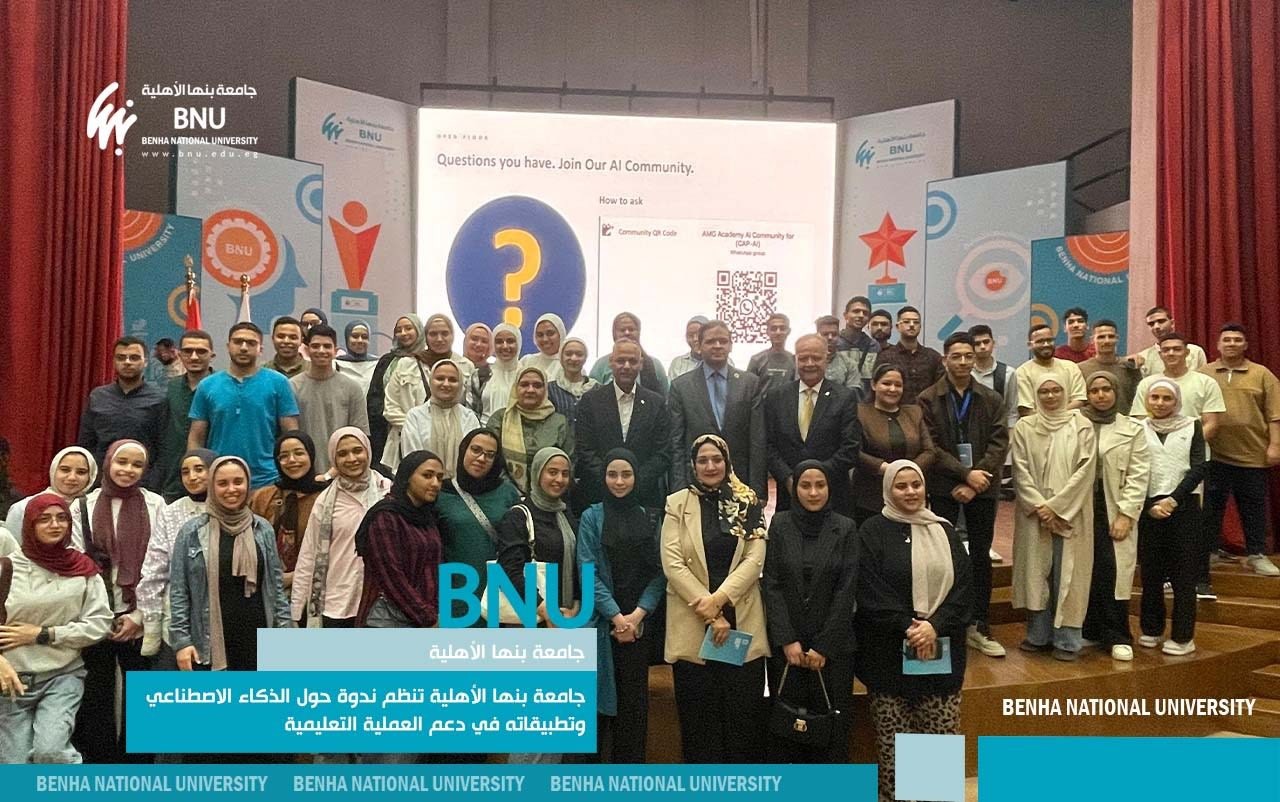
Benha National University organized an introductory seminar entitled “Artificial Intelligence – Professional Training Program” under the patronage of Prof. Tamer Samir, President of the University, as part of its commitment to keeping pace with technological advancement and promoting a culture of innovation and digital transformation across the educational system.
The seminar was attended by Prof. Mahmoud Saqr, Advisor to the President for Research and Innovation; the University’s program directors; and Prof. Mohamed Anwar, Director of the Continuing Education Center. The keynote lecture was delivered by Prof. Ahmed Heikal, Vice Chairman of AMG Group, with the participation of faculty members and students.
Prof. Tamer Samir emphasized that Benha National University places great importance on integrating artificial intelligence technologies into teaching and research in ways that enhance educational outcomes and better prepare students for labor market demands. He noted that digital transformation has become an essential requirement for keeping pace with rapid global developments.
He added that the University remains committed to fostering an advanced learning environment rooted in innovation and knowledge, with a strong focus on developing students’ competencies in emerging technologies to strengthen their competitiveness in both local and international labor markets.
The seminar explored the growing significance of artificial intelligence and its applications in supporting the educational process. Discussions highlighted its role in helping faculty members efficiently prepare and analyze student statistics and academic data, as well as its contribution to assisting students through lecture summarization and the simplification of academic content, thereby enhancing the overall quality of teaching and learning.
The seminar also reviewed practical applications of artificial intelligence across several vital sectors, including healthcare particularly in oncology hospitals, where AI supports the rapid and accurate classification of medical cases. Additional examples included its use in companies for data analysis, performance evaluation, and decision support; in software development, where it facilitates coding and accelerates programming workflows; and in advanced data analytics, enabling precise and efficient extraction of insights.