
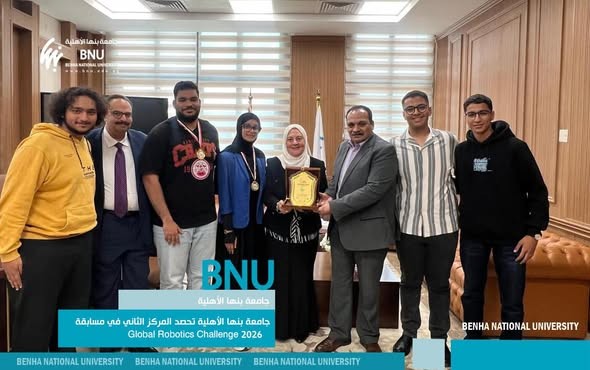
Benha National University has achieved a new milestone in its growing record of accomplishments in advanced technology, with its “Falcons” team earning second place in the Global Robotics Challenge 2026 (GRC) in the F1 Racing Challenge track. Hosted by The British University in Egypt, the competition attracted strong participation from universities across Egypt and the Arab region.
This achievement reflects the University’s continued commitment to encouraging student participation in scientific and technological competitions and to fostering an educational environment that promotes innovation and creativity, while preparing graduates to compete regionally and internationally in emerging technology fields.
The award marks the culmination of three months of intensive preparation and development, during which the team produced an outstanding project that showcased exceptional innovation, effective teamwork, and the practical application of engineering knowledge in a highly competitive setting.
The winning team included students from Benha National University’s Faculty of Computer Science: Sajed Walid (second year), Mariam Adel (third year, Artificial Intelligence Program), Omar Ali (first year), and Mostafa El-Sayed (third year, Artificial Intelligence Program). The team also included Adham Ayman (second year, Mechatronics Program) and Seif Hisham (fourth year, Mechatronics Program) from the Faculty of Engineering.
The Global Robotics Challenge (GRC) is one of the region’s leading robotics competitions, featuring multiple tracks, including Sumo, Robot Tug of War, Remotely Operated Vehicles (ROV), F1 Racing, and Robot Billiards. The competition is organized across three age categories Junior, Senior, and Adult with Benha National University competing in the Adult category.
The 2026 edition brought together participants from more than 20 universities, along with teams representing over eight Arab countries, including Saudi Arabia and Yemen, underscoring both the intensity of the competition and the significance of the University’s achievement.
The competition was conducted over several stages, beginning with project presentations, followed by qualifying rounds and semifinals, and concluding with the final round, in which teams presented their models to the judging panel before competing in the practical challenges.