
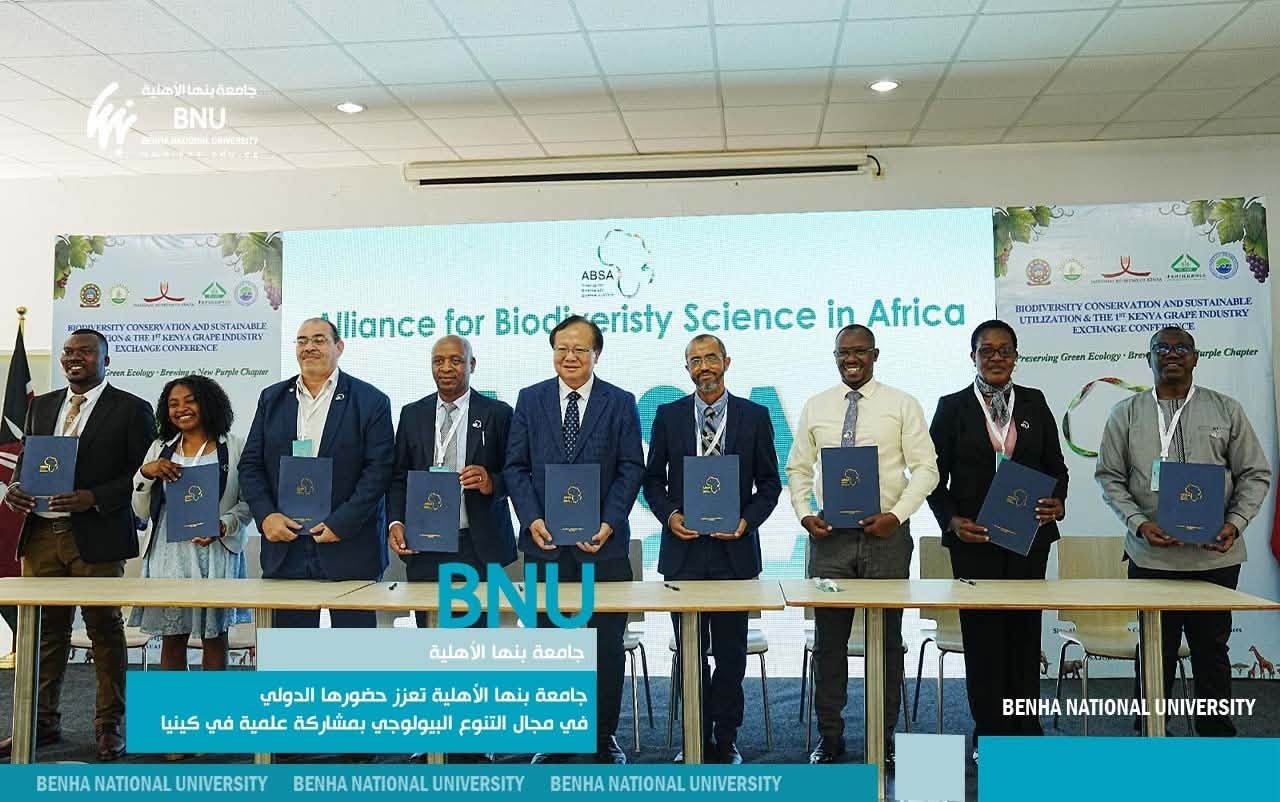
Under the patronage of Prof. Tamer Samir, President of Benha National University, and Prof. Mahmoud Saqr, Vice President for Employment, Innovation and Entrepreneurship and Supervisor of the Center for Converging Sciences and Emerging Technologies (CoSET), Prof. Mohamed Hamdy Ammar, Visiting Professor at CoSET, participated in the “Biodiversity Conservation and Sustainable Use” academic conference and workshop in Kenya from 11 to 15 August 2026. The participation reflects the University’s commitment to advancing scientific research and strengthening international academic cooperation.
The event was held under the auspices of the Sino-Africa Center of the Chinese Academy of Sciences, in cooperation with Jomo Kenyatta University of Agriculture and Technology, with researchers and experts from several African countries taking part. The event supported scientific and research cooperation in biodiversity and sustainability.
As part of the scientific programme, Prof. Mohamed Hamdy Ammar delivered a presentation entitled “Plant Biodiversity in the Era of Genomics: An Egyptian Flora Perspective”. The presentation highlighted the role of genomics and modern technologies in studying plant biodiversity, with particular focus on Egyptian flora. It also addressed the importance of documenting biodiversity, examining its components, and promoting the sustainable use of plant resources in light of recent advances in genomics and biotechnology.
The conference also saw the launch of an academic and scientific research alliance for biodiversity researchers in Africa, bringing together researchers from Egypt, Kenya, Rwanda, Burundi, Tanzania, Zimbabwe, and Ethiopia, with support from the Sino-Africa Center for Research and Studies of the Chinese Academy of Sciences.
Prof. Tamer Samir, President of Benha National University, affirmed that the University’s participation in international scientific events reflects its commitment to supporting scientific research and encouraging its researchers to engage with scientific and environmental issues of international interest. He noted that cooperation with the Chinese Academy of Sciences and African research institutions offers valuable opportunities for knowledge exchange and the development of new research partnerships.
He added that broader cooperation in biodiversity, sustainability, and emerging technologies would strengthen the University’s international scientific presence and support its efforts to develop effective research partnerships with scientific institutions worldwide.
Prof. Mahmoud Saqr, Vice President for Employment, Innovation and Entrepreneurship and Supervisor of CoSET, underscored the importance of international research partnerships in supporting innovation and advancing joint scientific projects. He highlighted the role of scientific research in addressing environmental challenges and supporting sustainability efforts.
He further noted that international scientific events provide University researchers with new opportunities to connect with researchers, experts, and scientific institutions worldwide, exchange expertise, and develop research partnerships that contribute to generating knowledge with practical applications and support sustainable development.
The participation forms part of Benha National University and CoSET’s efforts to expand international scientific and academic cooperation, strengthen the participation of University researchers in international conferences and scientific events, facilitate knowledge and expertise exchange, build international research networks, and support joint projects in biodiversity, sustainability, and emerging technologies.
The participation of Prof. Mohamed Hamdy Ammar further reflects Benha National University’s growing international scientific presence and its commitment to advancing research and innovation, while building strong links with universities, research centres, and scientific institutions worldwide. It also reflects the University’s vision as a modern institution open to the world and actively engaged in scientific, environmental, and development issues of international interest.